The EcoBell4 sets new standards in paint application—delivering greater efficiency, sustainability, and precision. At beta sites, it becomes clear how powerful this technology is in day-to-day painting operations.
The demands on modern painting processes are constantly rising: more colors, a wider range of model variants, shorter cycle times—all while maintaining maximum efficiency and sustainability. This is precisely where Dürr’s EcoBell4 generation demonstrates its capabilities today. In various use cases, we impressively demonstrate how these requirements are successfully achieved. The technology is designed to apply paint precisely, efficiently and reliably, while significantly improving system availability.
New application technology is tested at selected customer sites—known as beta sites—under real production conditions prior to full-scale deployment. A beta site is not a laboratory experiment, but a real operational painting line. There, the technology must consistently demonstrate stable operation, deliver the required quality, and integrate seamlessly into the existing processes. The EcoBell4 has been tested at multiple locations for various application areas.
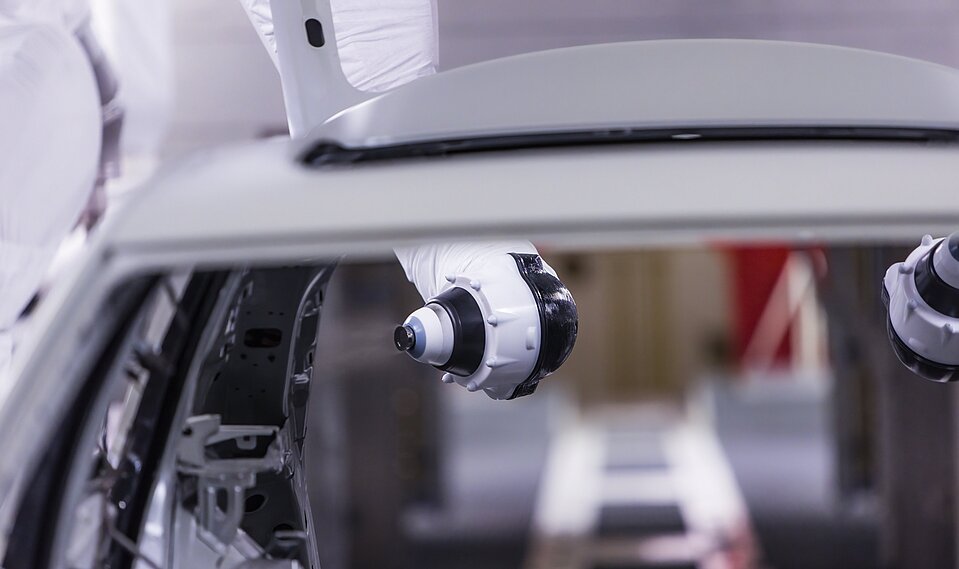
Up to 370 car bodies without interruption—EcoBell4 optimizes the primer application with high efficiency and reliability.
Case 1: Efficient Primer Application
In this scenario, the EcoBell4 Pro E 2x1K and EcoBell4 Pro Ci 2x1K were used for primer application. The applicator handles both interior and exterior primer applications and can coat up to 370 vehicle bodies per shift without any loss of quality. Cleaning intervals have also been extended. When applying primer to the outer surfaces of the vehicle body, the applicator can operate continuously for several hours before manual cleaning is required. This reduces production interruptions. The system is supported by an integrated vibration sensor which continuously monitors the rotational movements of the bell plate. This allows even the slightest imbalances to be detected early, before they lead to malfunctions.
This early detection helps prevent damage to the atomizer turbine and effectively minimizes unplanned system downtime. The integrated RFID (Radio Frequency Identification) technology is a wireless method in which a reader detects a small transponder with an antenna—known as a tag—without physical contact. The tag can transmit stored information, which the system reads and continuously updates automatically. The technology also ensures that maintenance procedures become simpler and more transparent. This combination of extended operating times, consistent quality, and intelligent monitoring clearly demonstrates how the EcoBell4 Pro increases system availability and enhances overall painting efficiency.
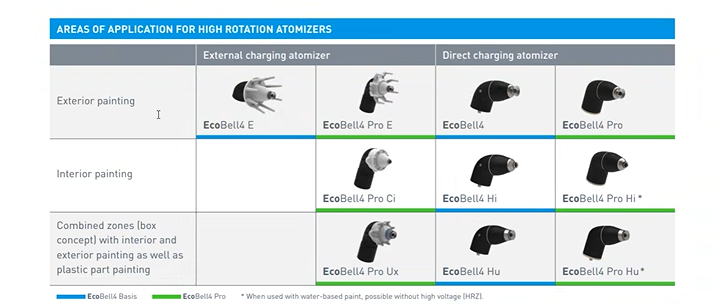
With EcoBell4 Basis and Pro, there is a high-speed rotary atomizer available for every painting application.
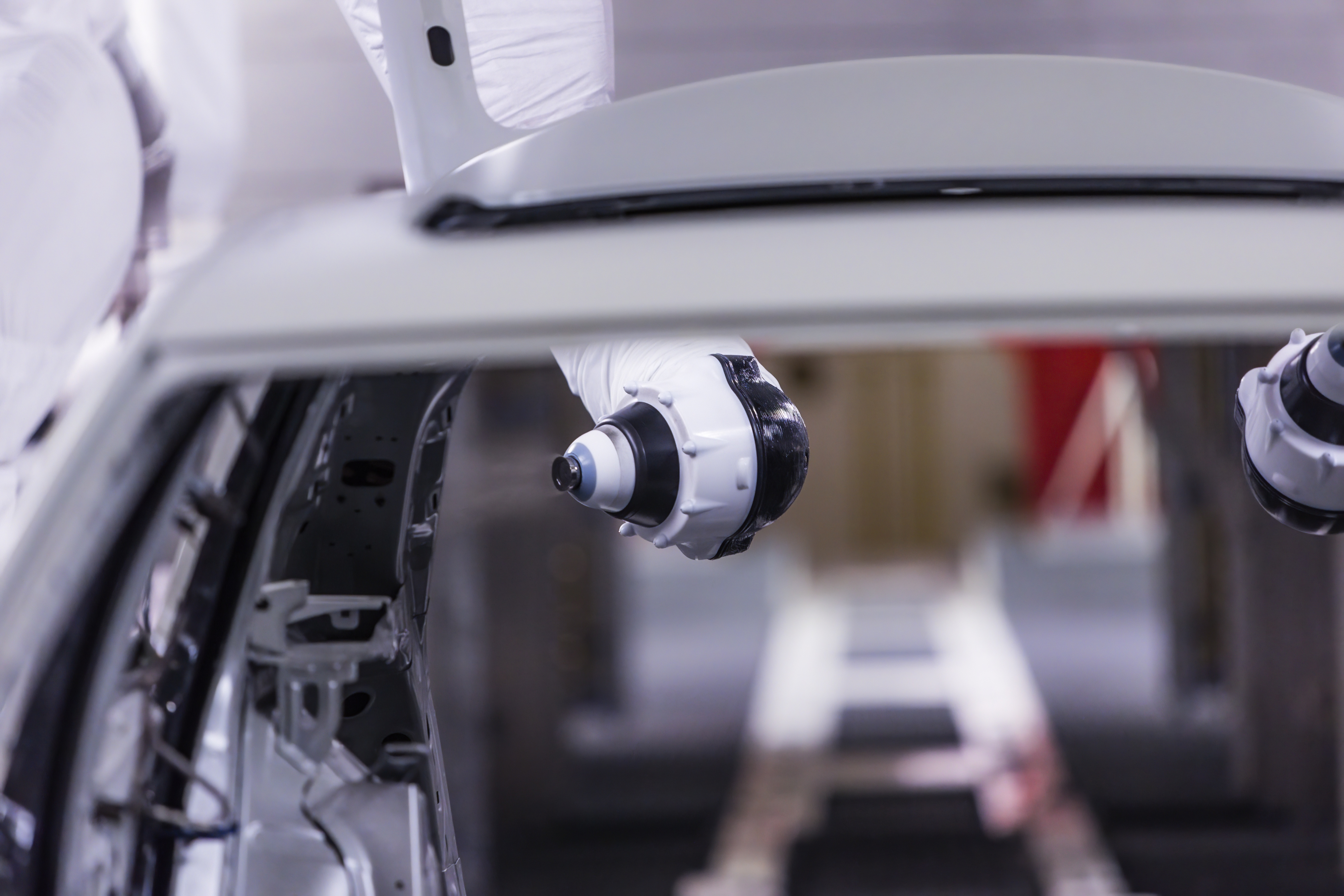
EcoBell4 significantly reduces VOC emissions and cuts color changeover times to just 15 seconds, promoting greater sustainability.
Case 2: Clean, fast, and with maximum VOC reduction
The next case highlights an innovation that is crucial for achieving high-quality finishes. The EcoBell4 Pro 2x2K recirculation system operates here with two independent 2K systems. In conventional flushing processes, residual paint and solvents enter the booth and release volatile organic compounds (VOCs) there. In many cases, more than 70% of the booth air can become contaminated. Our new solution innovation prevents mixed 2K paint from being flushed forward through the atomizer. Instead, it is directed back through the atomizer into a dedicated recirculation line. This virtually eliminates VOC emissions into the booth during color changes. As a result, collection systems such as funnels, drip separators, and purge boxes are no longer required. Up to two main needles dispense the two paint components, while diaphragm valve technology enables the components to be mixed directly within the atomizer, reducing color-change times. Flushing and priming operations in the second channel occur simultaneously with paint application in the first channel or during external atomizer cleaning. In this way, the 2K paint change process, including cleaning, is reduced to just 15 seconds. This creates more time for the actual painting, thereby increasing line throughput. RFID technology and a vibration monitoring ensure consistently stable operation.
EcoBell4 switches seamlessly between 1K and 2K—without compromising on quality.
Case 3: Flexible between 1K and 2K
Another beta site showcases the base version of the EcoBell4 as a capital-expenditure-optimized solution, providing customers with a durable and cost-effective painting solution for 1K basecoat and 2K clearcoat applications through a single applicator investment. This enables high paint quality with lower capital investment. In both methods, the processes run stably, and the line easily achieves daily outputs of up to 600 vehicle bodies. Here, too, an RFID-based maintenance solution ensures efficient operation, while the vibration sensor continuously monitors turbine performance in the background.
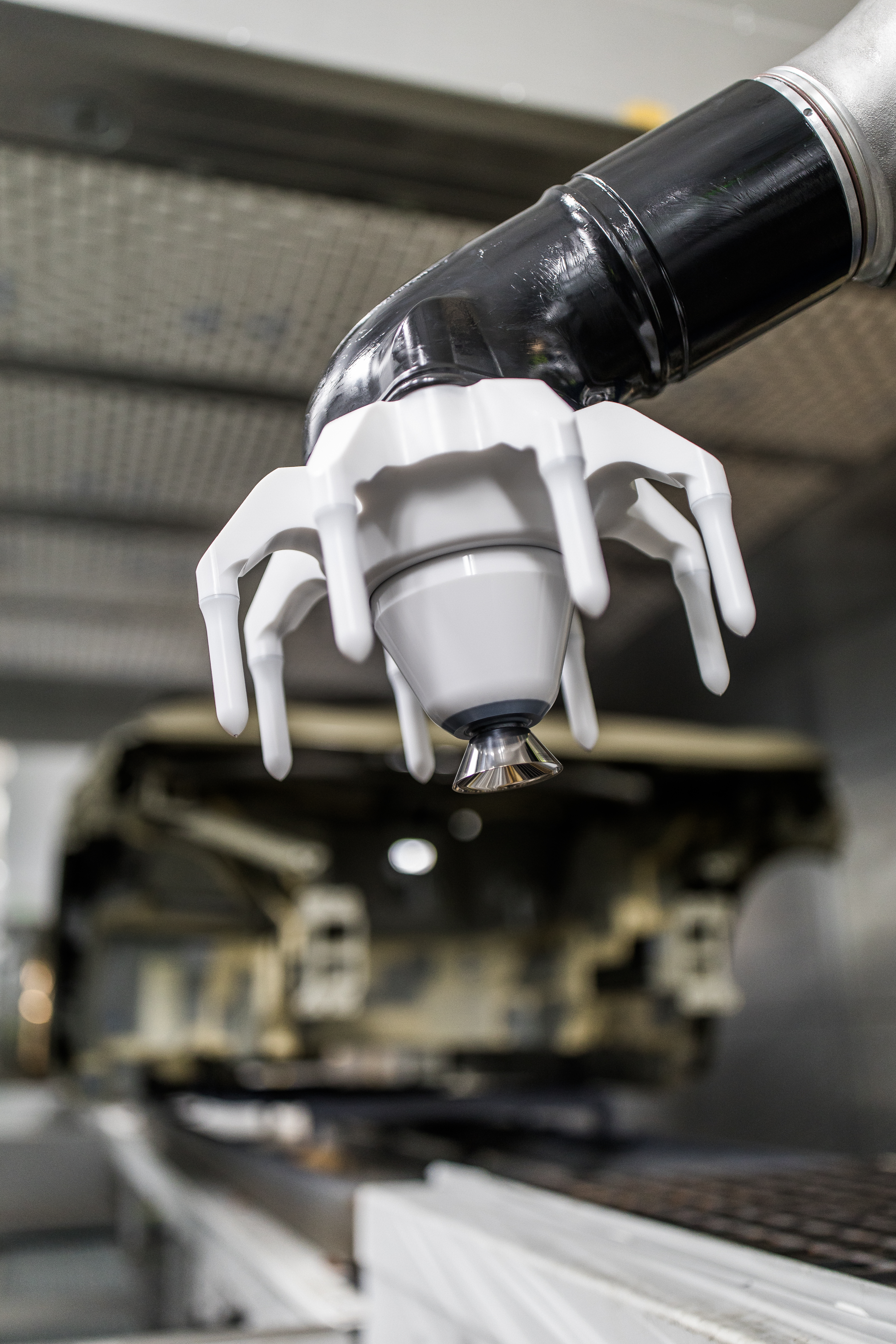
Four needles, quick color changes, lower consumption—that’s how EcoBell4 boosts efficiency.
Case 4: Four Main Needles for Faster Printing
At another beta site, the EcoBell4 Pro operates with four main needles. Three of these dedicated paint connections for high-volume colors, while the fourth main needle is connected to an upstream paint changer. This configuration ensures that multiple colors are immediately available at the atomizer, enabling significantly faster paint changes, as the high-volume lines do not need to be drained or flushed. This minimizes paint and rinsing agent losses. In two-shift operation, the system thus processes approximately 340 vehicle bodies per day. Thanks to the precise separation and rapid switching of the needles, both paint consumption and VOC emissions are significantly reduced. At the same time, RFID and vibration sensors ensure consistently reliable operation. The solution achieves maximum resource efficiency and actively supports more environmentally sustainable production.
We use cookies, similar technologies and tracking services
This website uses cookies, similar technologies and tracking services (hereinafter referred to as “Cookies”). We need your consent for Cookies, which not only serve to technically display our website, but also to enable the best possible use of our website and to improve it based on your user behavior, or to present content and marketing aligned with your interests. For these purposes, we cooperate with third-party providers (e.g. Salesforce, LinkedIn, Google, Microsoft, Piwik PRO). Through these partners you can also receive advertisements on other websites.
If you consent, you also accept certain subsequent processing of your personal data (e.g. storage of your IP address in profiles) and that our partners may transfer your data to the United States and, if applicable, to further countries. Such transfer involves the risk that authorities may access the data and that your rights may not be enforceable. Please select which Cookies we may use under ”Settings”. More information, particularly about your rights, e.g. to withdraw consent, is available in our Privacy Policy .