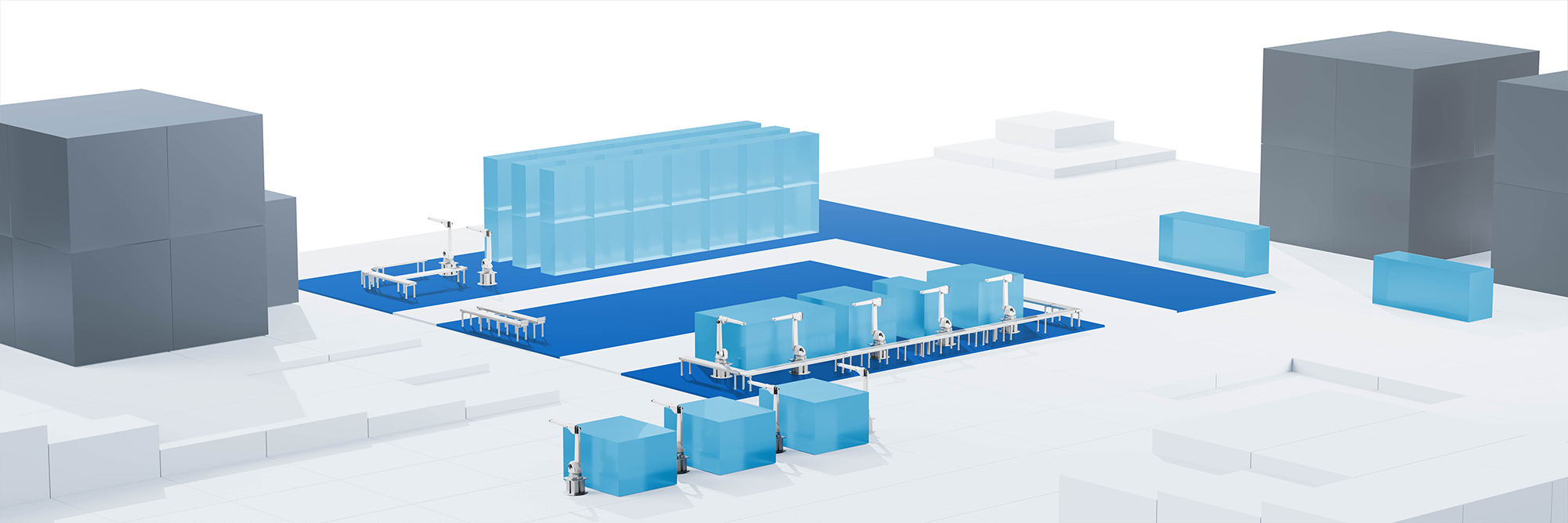
New vehicle architectures, changing production processes, and increasing demands for flexibility present automakers with a unique challenge: How can existing plants be further developed without disrupting ongoing production? This is precisely where brownfield integration comes into play. Dr.-Ing. Susann Kärcher, Senior Manager at Dürr Consulting, explains what matters most, which challenges companies often underestimate, and why an on-site assessment is often more crucial than any planning document.
As a senior manager at Dürr Consulting, Dr.-Ing. Susann Kärcher assists automakers in the further development of their existing plants.
Dr. Kärcher, many automakers are currently focusing on brownfield transformation. What does that mean specifically?
Brownfield projects involve working within existing production environments, such as in body shops, paint shops, or assembly lines. Unlike a greenfield or new-construction project, the goal is to integrate new requirements into established structures.
These requirements arise, for example, from new vehicle platforms, additional variants, or changes in production processes. The key question is: How can existing production systems be further developed without losing their performance? At its core, the goal is to make effective use of proven solutions while simultaneously laying the groundwork for future requirements.
The targeted further development of existing systems provides flexibility for future production requirements.
What questions arise at the start of a brownfield project?
First and foremost, our customers want to understand the potential of their existing production systems. After all, new requirements must be reconciled with ongoing series production, limited space, and existing equipment. Finding the right balance between preserving existing assets and ensuring future viability a highly complex starting point for many companies.
Typical questions include:
- Can new vehicle architectures be integrated into existing production lines?
- Which equipment can continue to be used?
- Where do bottlenecks arise in terms of floor space, material flow, or cycle time?
- How can modifications be made without significantly disrupting production?
- Which investments are truly necessary?
Our task is to create transparency and evaluate various scenarios. By developing an integration strategy tailored to each customer’s specific needs, we identify and assess a range of solutions. The sooner reliable decision-making criteria are available, the greater the scope for action.
What is particularly often underestimated in brownfield projects?
Many people assume that the available data fully reflects the reality on the factory floor. In practice, however, we often find that systems have been modified, expanded, or retrofitted over the years, and the documentation no longer reflects the current situation. That is why we do not rely exclusively on plans and documentation. We analyze the situation directly on site, collect relevant data firsthand, and verify the actual conditions at the plant. That’s often where the most important insights emerge. Only after we have a realistic picture can we make decisions that will work in practice.
Can you give a specific example of a project?
Certainly. In a project for an OEM, a new vehicle model was to be integrated into an existing final assembly line. The main challenge was the conveyor system: The new model had different weights and dimensions, which affected the existing plant structure.
First, we analyzed the existing conveyor system and determined which components could continue to be used and where adjustments were necessary. We then evaluated various scenarios in terms of investment requirements, feasibility, and impact on ongoing operations.
The real challenge, however, was implementing the necessary adjustments without significantly disrupting ongoing production. To achieve this, we not only defined the technical requirements and drafted the specifications but also developed a detailed implementation plan. We made strategic use of production breaks and scheduled downtime to minimize disruptions to ongoing operations and avoid downtime as much as possible.
This example illustrates the essence of brownfield projects: intelligently upgrading existing systems rather than rebuilding them from scratch.
Detailed integration strategies lay the foundation for an efficient and sustainable plant transformation.
What role does collaboration with the teams at the plant play?
A crucial one. The people on site often know their equipment and processes down to the smallest detail. This practical knowledge is enormously valuable in brownfield projects.
That’s why the best solutions are developed through close collaboration with the plant teams. Our job is to combine this knowledge with methodological expertise, project experience, and a neutral outside perspective. This results in concepts that are not only technically sound but also practical to implement in daily operations.
To conclude: What advice would you give to companies facing a brownfield project?
My advice would be: Start early and don’t view the project solely as a renovation effort. Those who wait too long to begin the analysis often unnecessarily limit their own room for maneuver. As a result, solutions quickly become more complex, more expensive, or riskier. At the same time, it’s worth asking not what needs to be replaced, but what can be preserved and further optimized. That’s often where the greatest economic potential lies.
Ultimately, brownfield projects aren’t just about individual facilities or processes. They’re about ensuring the future viability of a production system and laying groundwork for upcoming changes.
Furthermore, it’s important to bring a partner on board early who understands both the strategic perspective and the industrial reality. This is precisely where we see our role at Dürr Consulting: working alongside our customers to develop feasible, robust, and future-oriented solutions.
Brownfield integration: Shaping future-proof capabilities in existing facilities
Brownfield integration means far more than simply modernizing individual pieces of equipment. It determines how flexibly and adaptably existing production sites can respond to new requirements. Dürr Consulting supports automotive manufacturers throughout this process—from analysis and concept development to implementation during ongoing operations. Through customized layout planning, integrative strategies, and realistic implementation plans, we deliver solutions that streamline production processes and ensure long-term flexibility.
We use cookies, similar technologies and tracking services
This website uses cookies, similar technologies and tracking services (hereinafter referred to as “Cookies”). We need your consent for Cookies, which not only serve to technically display our website, but also to enable the best possible use of our website and to improve it based on your user behavior, or to present content and marketing aligned with your interests. For these purposes, we cooperate with third-party providers (e.g. Salesforce, LinkedIn, Google, Microsoft, Piwik PRO). Through these partners you can also receive advertisements on other websites.
If you consent, you also accept certain subsequent processing of your personal data (e.g. storage of your IP address in profiles) and that our partners may transfer your data to the United States and, if applicable, to further countries. Such transfer involves the risk that authorities may access the data and that your rights may not be enforceable. Please select which Cookies we may use under ”Settings”. More information, particularly about your rights, e.g. to withdraw consent, is available in our Privacy Policy .