The future is painted in pixels
Welcome, Dr. Bubek and Mr. Haller. You have both played a key role in the development of EcoNextJet. Can you briefly explain what it’s about?
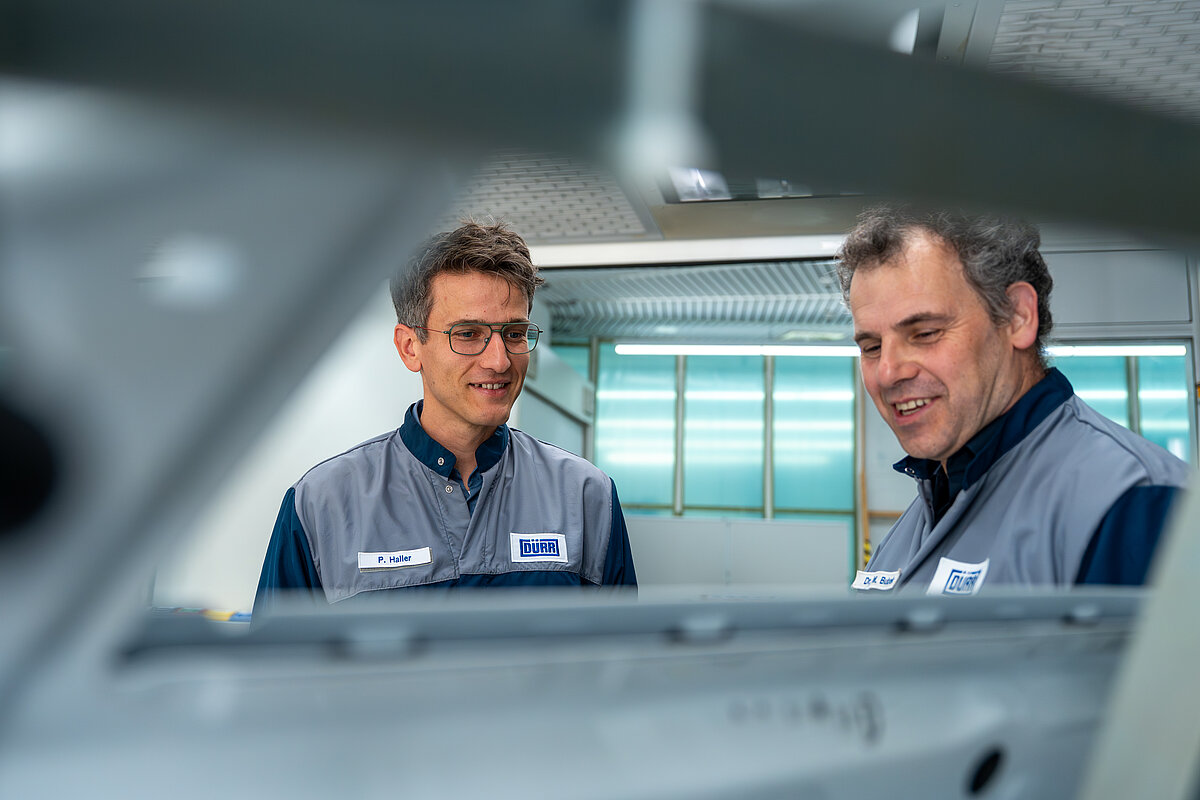
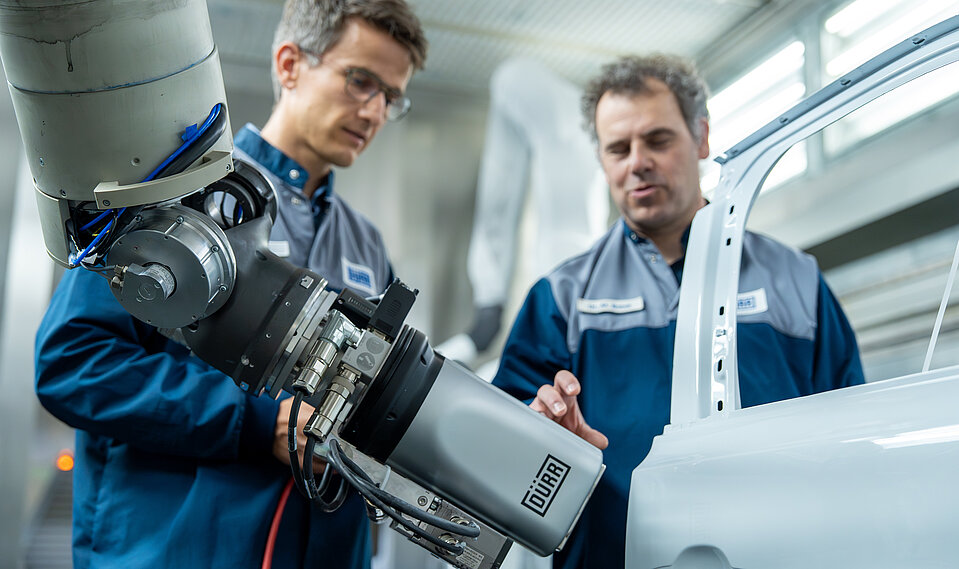
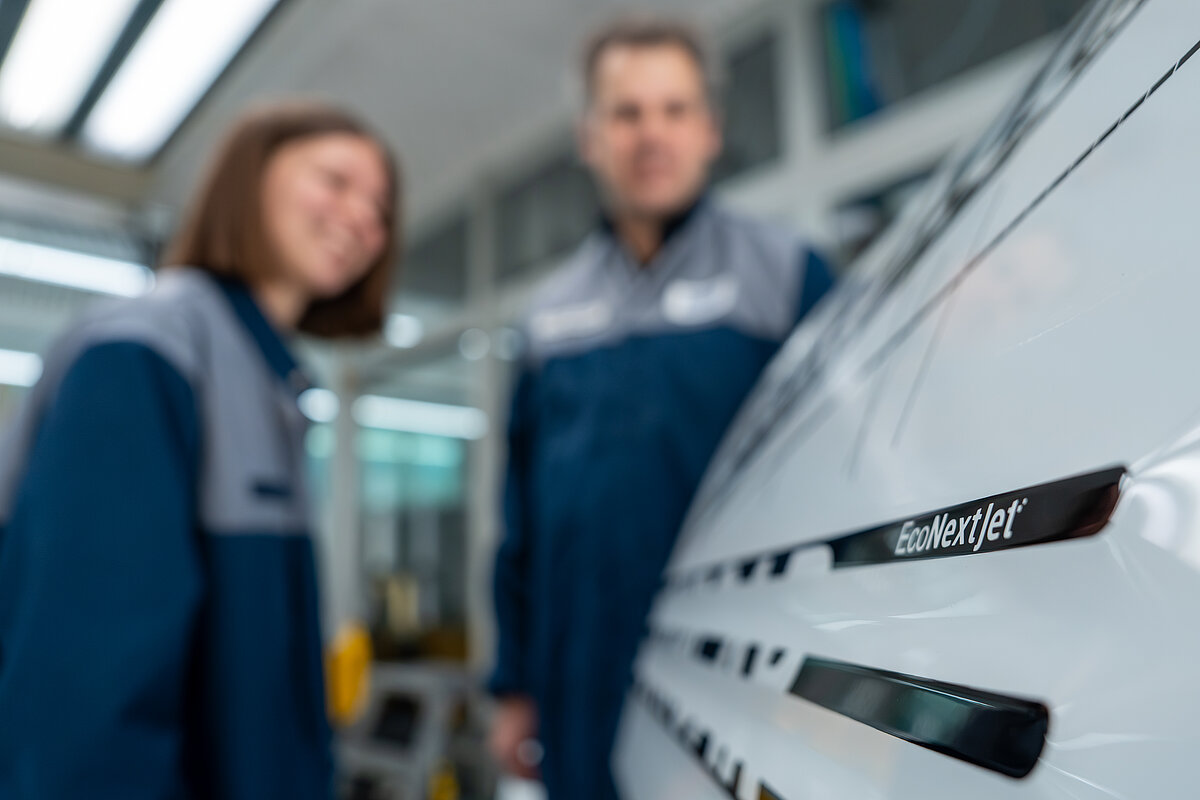
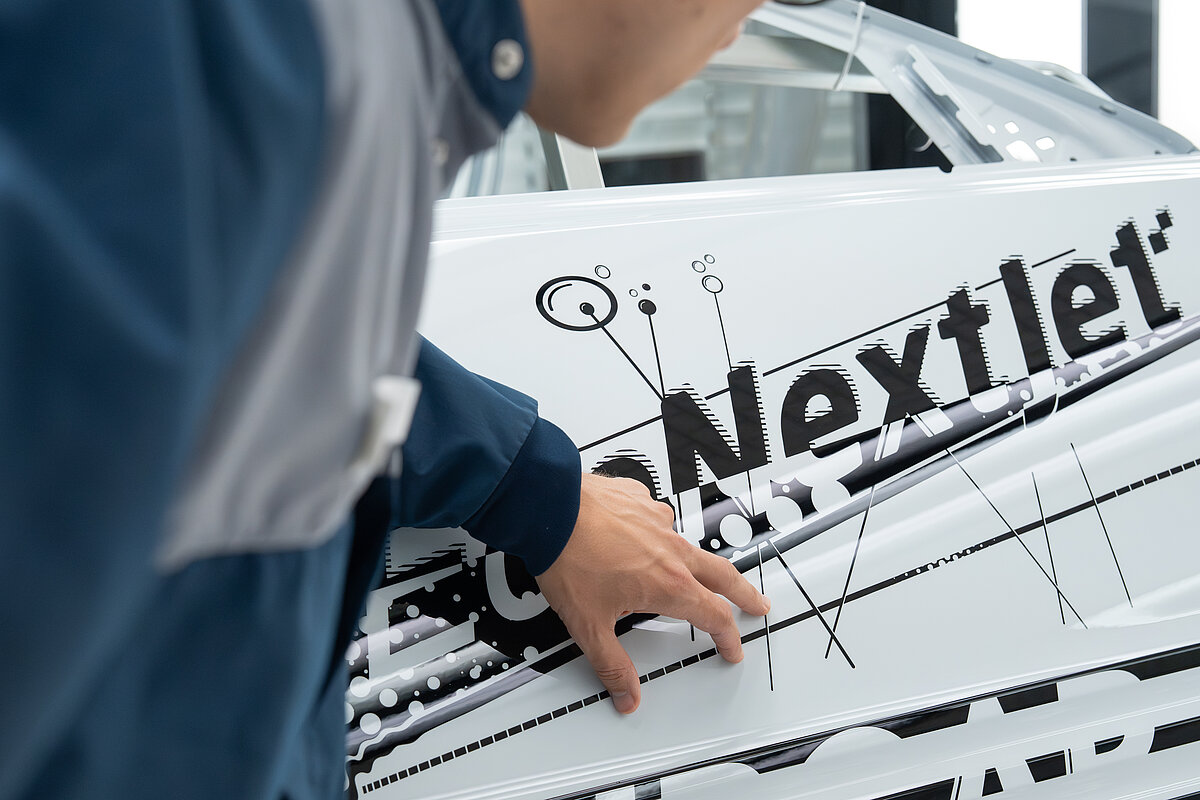
Peter Haller: I'd love to. The EcoNextJet is an application system that is attached to a painting robot. This allows graphics and decorative elements to be applied directly to the body in high resolution in the paint shop – on both horizontal and vertical surfaces.
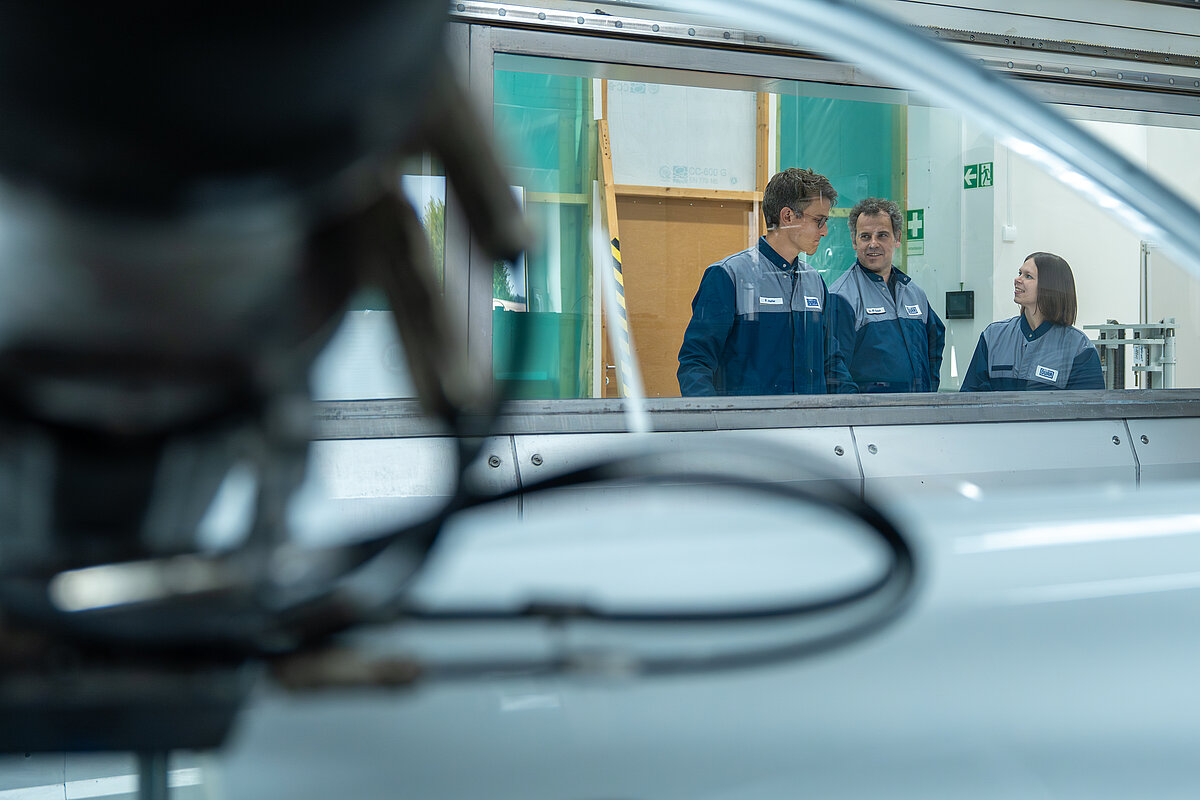
Dr. Moritz Bubek: This was made possible through cooperation with our partners, paint manufacturer Axalta and printhead manufacturer XAAR. Together, we developed a system that combines high-resolution graphics and designs with high-quality paint and precision robots.
What inspired you to develop the EcoNextJet? How did the collaboration with XAAR and Axalta come about?
Dr. Moritz Bubek: The idea arose from a clear trend: vehicles are becoming increasingly customized. With the EcoPaintJet Pro, we had already established an overspray-free system for contrasting roofs, which has performed very well on the market.
Peter Haller: In close consultation with our customers, it became clear that designers wanted even more freedom—especially when it comes to high-resolution graphics. After evaluation, we decided to collaborate with Axalta and XAAR. Matching the paint to the applicator is a complex process, but thanks to this partnership it has already been completed. This saved valuable development time. Thanks to the collaboration, Dürr can now offer a complete system that meets the requirements of the automotive industry.
Let's go into a little more detail. What advantages does the EcoNextJet offer vehicle manufacturers?
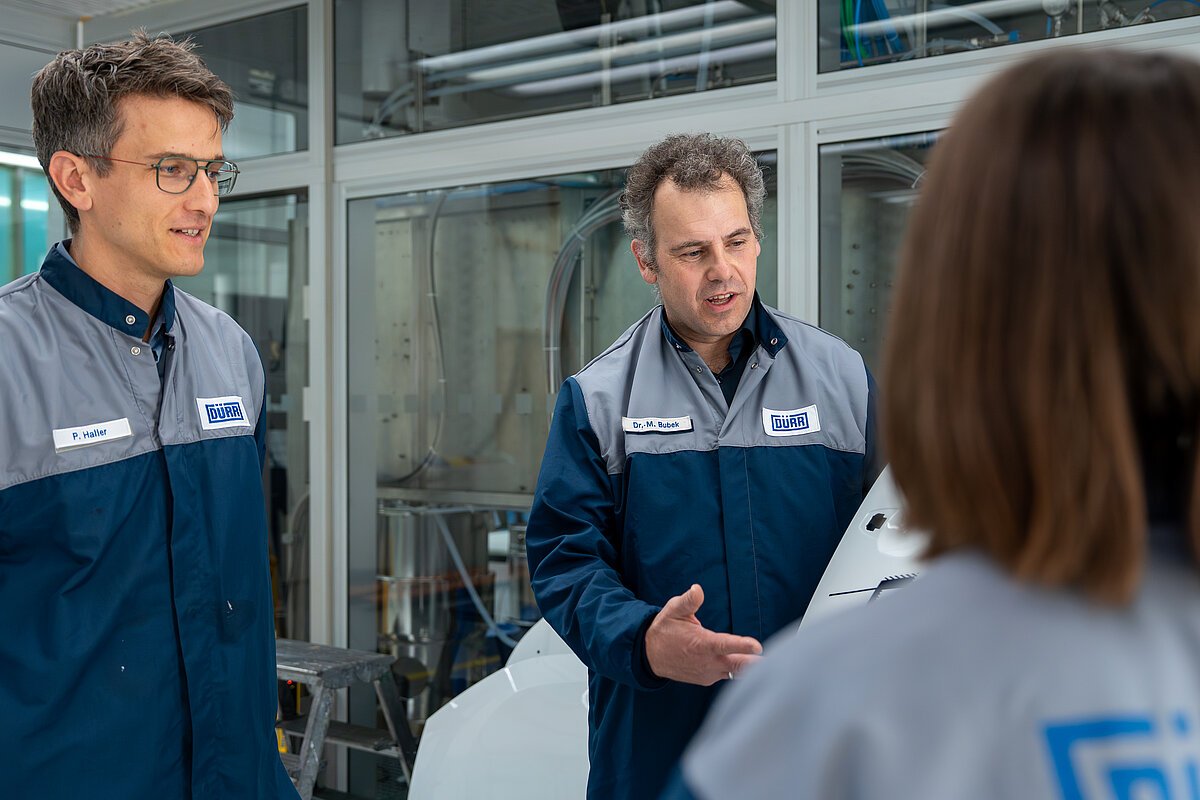
Peter Haller: One key advantage is automation. Manual steps such as applying design films are eliminated. Our printing speed is significantly higher than that of our competitors. Customers can apply design elements to a wide variety of surfaces. The print head can even print two colors at the same time – and we are working on further expanding the color spectrum with our color changer. The possibilities for customization are huge, as we recently demonstrated at the Surcar conference in Cannes.
That sounds impressive. What technology is behind this quality?
Dr. Moritz Bubek: The print head is based on drop-on-demand technology. This applies drops of ink precisely and accurately to the surface using proven piezo technology, which literally “squeezes” the drops out.
You just mentioned that two colors can be used simultaneously from the same print head. What potential do you see in that?
Peter Haller: It opens completely new possibilities for multi-colored and complex designs. Color changes are no longer necessary, color-changing times are shorter – and the result is high-quality, unique vehicles.
Let's take a closer look at the surfaces. Which surfaces offer the greatest potential – horizontal or vertical?
Dr. Moritz Bubek: Ultimately, that's up to the customer. The big advantage of our system is that we can coat both horizontal and vertical surfaces with the same coating material – without changing the type of coating. This gives you maximum design freedom.
You just mentioned drop-on-demand technology. How does it work?
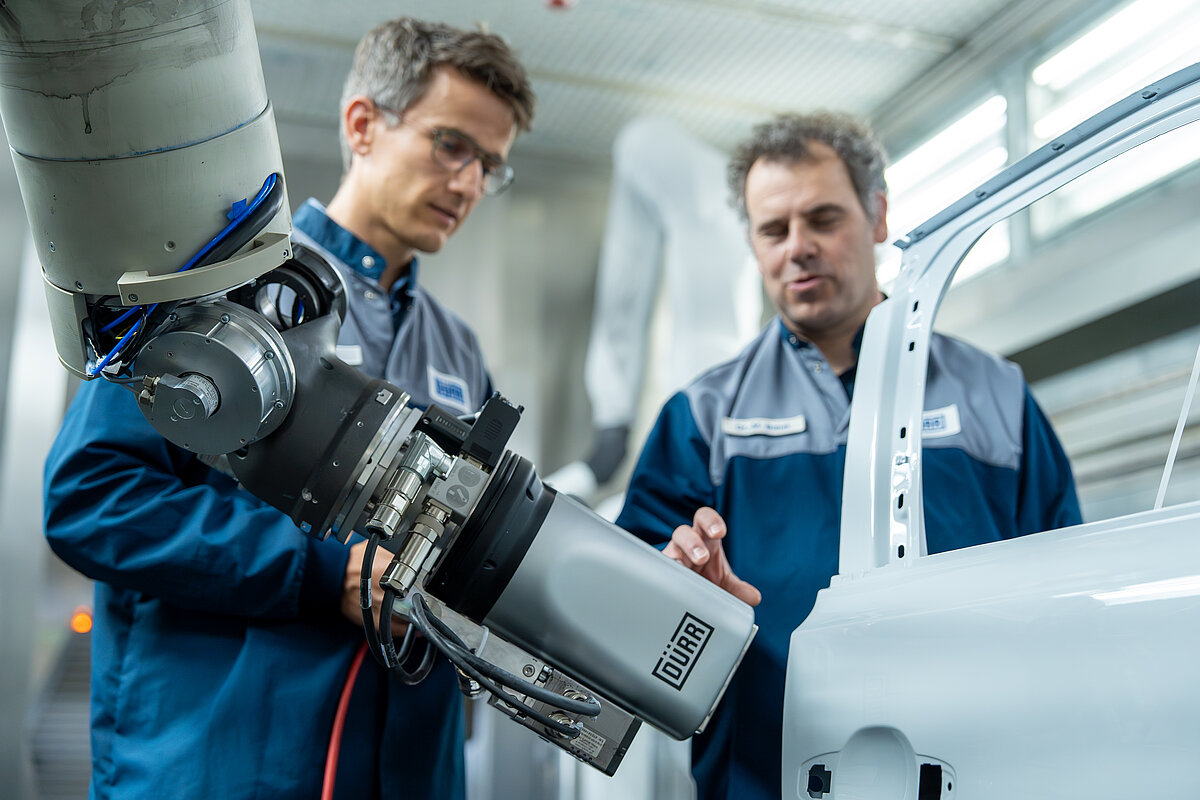
Dr. Moritz Bubek: Gladly. Drop-on-demand – DoD for short – means that each individual nozzle can be controlled independently. This allows us to apply any graphics and patterns with precision. With EcoNextJet, we use a print head that has over 2,000 nozzles arranged side by side. Each nozzle applies tiny drops of coating precisely to the surface.
Peter Haller: The nozzles consist of small coating chambers that are open at the front. The walls of these chambers are made of a special ceramic material that deforms when an electrical voltage is applied. This so-called piezoceramic material uses sophisticated acoustics – we refer to these as “waveforms” – to transfer energy into the coating material. This causes a drop measuring just a few picoliters to be ejected from the nozzle.
Dr. Moritz Bubek: And that's not all: up to six drops can be generated per image point – i.e., per pixel – which can merge into a larger drop while still in flight before hitting the substrate. This allows us to control drop size and speed with extreme precision.
Peter Haller: To ensure that these drops are perfect, the coating material must circulate in the system. The circulation ensures that the paint flows, is pre-sheared, and harmful air bubbles are removed. The challenge here is regulating the pressure in the paint chamber to within a few millibars. Since the system is open at the front, the paint must not simply run out – it must remain applicable with minimal energy.
So, it's a complex system. What role does the software play?
Dr. Moritz Bubek: A central role. The software is the link between mechanics, control, and measurement technology. Existing software components such as the path generation in the EcoPaintJet help us, but much must be newly developed for the EcoNextJet – such as calculating the point of impact of each individual drop.
What areas of application do you see for the EcoNextJet?
Peter Haller: The high resolution enables designs that were previously unthinkable. Even the customization of individual customer vehicles is realistic. We demonstrated this live at SURCAR in Cannes – with a signature painted directly onto a vehicle. That was a real wow moment.
Are competitors developing similar products, or is Dürr ahead of the game here?
Dr. Moritz Bubek: With the EcoPaintJet Pro, we are the market leader in overspray-free paint application. Several systems are already in productive operation. Of course, others are also working on vehicle customization. But our advantage is the complete ecosystem of software, hardware, and processes—that's what makes the difference.
Speaking of the future, what are the next steps?
Peter Haller: We still have a lot ahead of us. The EcoNextJet needs to be fully developed and prepared for use by customers. We are already in concrete talks with potential customers.
Dr. Moritz Bubek: At the same time, our partner Axalta is working on bringing additional colors and coating systems to market. This is crucial to offering customers the widest possible range of design options.
Finally, I have a slightly more personal question for you. What graphic would you like to have painted on your car?
Both laugh: During our tests, we came up with some geometric patterns that we really liked.
FURTHER RELATED
ARTICLES

What is EcoReflect?
a project name
a software that analyzes ecological data
a product
an innovative light tunnel
Read more
Back to Quiz
EcoReflect is an innovative light tunnel for controlling surface quality.
A new level of efficency in chair production
Interstuhl relies on modern coating technology from Dürr for the production of its work chairs for industrial and laboratory applications.
EcoBell in Industrial Painting
One spray, one splash of color, one wow effect. The EcoBell2 turns every candle into a little highlight in the USA.